


Hidden Rahu-Mars Nakshatra Exchange: Japan’s Defence Rise or Militarism in East Asia?
Updated: Sep 2
Introduction
At the Shangri-La Dialogue in Singapore, Japan’s Defence Minister Shinjiro Koizumi firmly rejected China’s accusations of “new militarism.” He asserted that every country, including Japan, has the right to update its defenses to meet new challenges and contribute to regional peace. Koizumi highlighted the contradiction: China maintains a huge arsenal of nuclear weapons and strategic bombers, while Japan possesses neither. He described China’s rapid military expansion and lack of transparency as a serious concern for Japan and the international community.

Geopolitical Situation in East Asia
East Asia is witnessing rising tensions. China’s assertive behaviour in the South China Sea, frequent military activities around Taiwan, and massive military modernisation have created alarm across the region. In response, Japan under Prime Minister Sanae Takaichi (since October 2025) has begun its most significant defence overhaul in decades.
Why Japan is Boosting Defence?
Japan is increasing its defense budget for the 12th consecutive year, with the latest budget exceeding 9 trillion yen (approx. $57 billion). The country is investing in advanced surface-to-ship missiles, unmanned drones (land and underwater), and has relaxed rules for exporting lethal weapons. Plans are also underway to revise key security documents and Article 9 of the constitution — Japan’s long-standing pacifist clause. These developments have triggered domestic anti-war protests and sharp criticism from China, raising an important question: Is this a legitimate Defence Rise or the beginning of Militarism?



Japan’s Sagittarian Foundation: Ethics and Traditional Values Endure
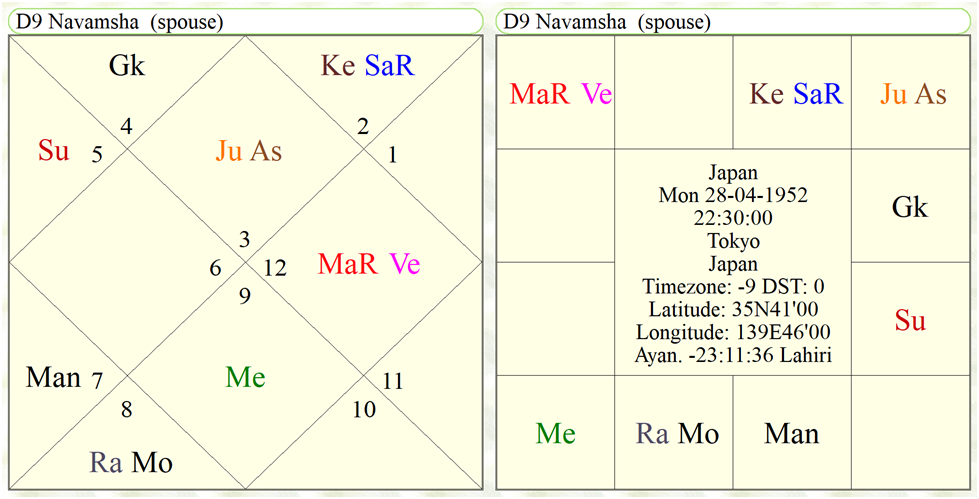
Let us find the truth from the Horoscope of Japan, as documented in The Book of World Horoscopes by Nicholas Campion. It has a Sagittarius Lagna Chart with Lagna Lord Jupiter powerfully aspecting the Lagna. In the Navamsa chart, Jupiter again occupies the Navamsa Lagna in mutual sign exchange with the Navamsa Lagna Lord Mercury.
This strong Jupiterian influence in both the Rashi and Navamsa charts clearly shows that the Japanese people remain deeply rooted in their traditional values, ethics, and discipline. Even while modernizing its defence capabilities, Japan continues to operate under Jupiter’s protective and moral influence.
Japan’s Economic Strength: Foundation for Defence Rise
Japan is an advanced, high-income mixed economy — the fourth-largest in the world by nominal GDP and fifth largest by PPP. This economic strength is supported by a powerful Jupiter Rajayoga (as per B.P.H.S Chapter 40, Shloka 25), with Jupiter aspecting the D-1 Lagna, sitting in the D-9 Lagna, and aspecting the D-3 Lagna. This gives Japan the financial stability and capacity to comfortably fund its major defence modernisation.
Current Planetary Period: Hidden Rahu-Mars Nakshatra Exchange in Ketu-Rahu-Mercury Dasha
Japan is currently running Ketu Mahadasha, Rahu Antar Dasha, and Mercury Pratyantar Dasha. Rahu is placed in the 3rd House and is in a hidden Nakshatra exchange with Mars (Rahu in Dhanistha, Mars in Swati). This Rahu-Mars Nakshatra exchange is the key astrological driver. Rahu represents technology and bold efforts, while Mars governs weapons and the armed forces. Together, they are strongly pushing Japan’s defence technology advancement and strategic modernization.
Ketu’s Special Role: Ketu in the 9th House under Jupiter’s aspect[Lagna Lord, 4th Lord] forms a Rajayoga, supporting strategic rise while preserving higher principles.
Supporting factors:
In D-10: Mars in its own sign (3rd house, retrograde) with mutual aspect from Lagna Lord Saturn — indicating military alertness and border tensions.
In D-60: Rahu + Mars in the 9th under 6th Lord Moon’s aspect — confirming innovation in weapons and defense technology.
· Mars’ Powerful Rajayogas: Weapons, Gains, and Alliances
In the D-1 chart, Mars as 5th Lord in the 11th House forms strong Rajayogas with Jupiter and Sun. In Navamsa, Mars (6th & 11th Lord) joined with Venus and connected to the 12th Lord, strongly supporting weapon exports, overseas defence cooperation, and new alliances.
Future Outlook (2026–2027)
Rahu Antar Dasha (till 29 November 2026) will accelerate new defence partnerships and self-driven efforts. Since Rahu is under Nakshatra exchange with Mars and placed in the 3rd House of courage and initiatives, this period will bring bold actions, rapid technological development in weapons, and the formation of new strategic alliances with friendly nations. The influence of Mars will give aggression and speed to Japan’s defence modernisation programme.
Jupiter Antar Dasha (from 29 November 2026 to 5 November 2027) will bring visible gains in defence exports and international agreements. Jupiter, as Lagna Lord, aspects the 11th House of gains and alliances. Jupiter is conjunct Sun the 9th Lord Sun[Rajyoga] and under the aspect of 5th Lord Mars [ Rajyoga]. In D-9, Jupiter is in sign exchange with the Navamsa Lagna Lord Mercury and under the aspect of Mars (weapons & armed forces). This powerful combination indicates success, major contracts, increased export of defence equipment, and stronger international military cooperation for Japan during this phase.
Conclusion
The Hidden Rahu-Mars Nakshatra Exchange in the Ketu-Rahu-Mercury period is powerfully fuelling Japan’s defence modernisation. While strong Jupiter keeps Japan’s actions largely defensive and value-based, the planetary combinations indicate Japan will emerge as a significantly stronger military and technological power in East Asia. This astrological setup suggests Japan’s rise will gradually challenge China’s regional hegemony in the coming years (2026-2027). Whether the world ultimately views this as a Defence Rise or Militarism will continue to be debated, but the stars clearly favour increased strength and strategic assertiveness.
“Rahu gives the technology, Mars gives the power, but Jupiter decides whether it becomes aggression or defence.”
Written and researched by Sunil Dutt


Comments